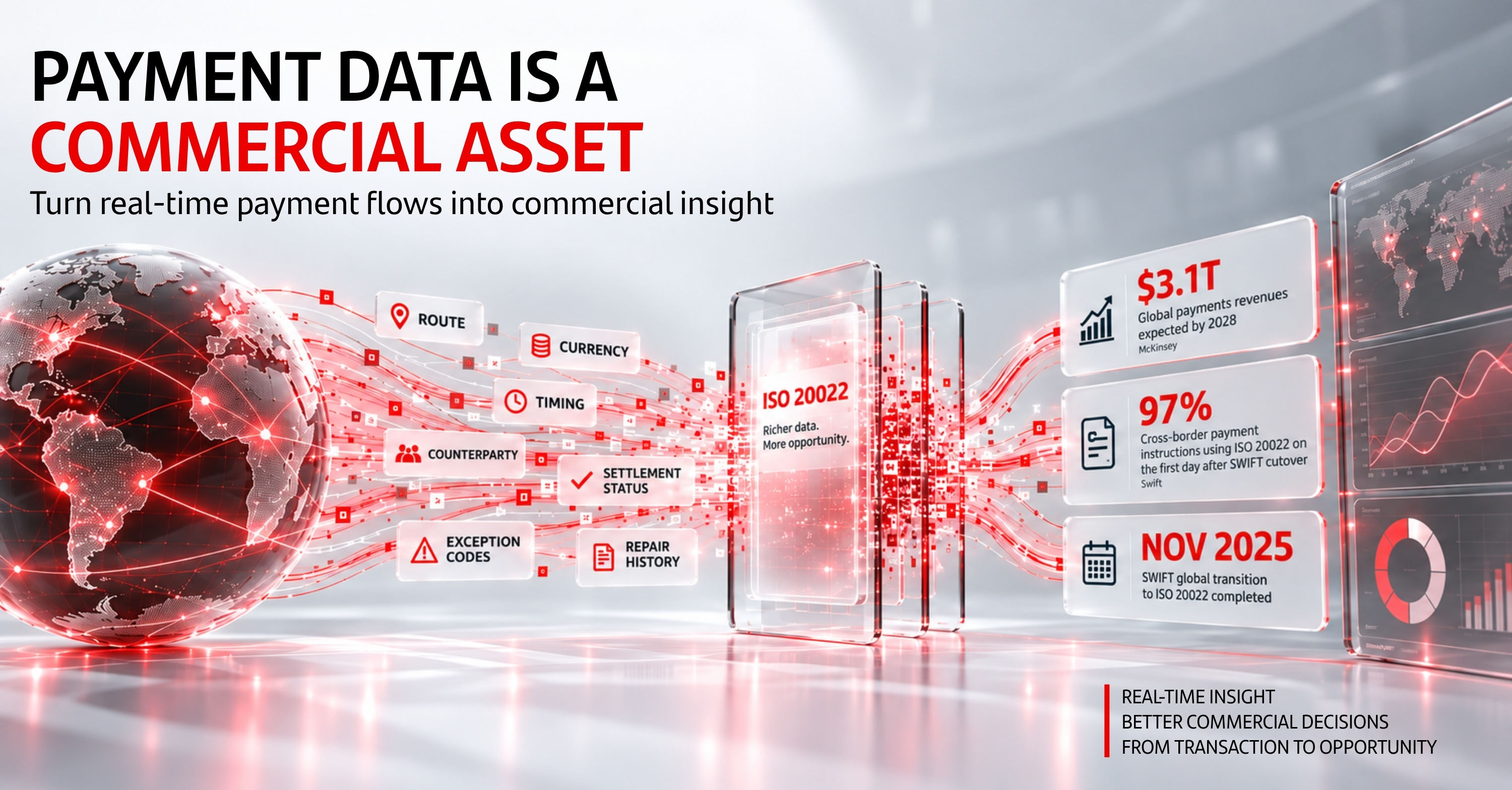
The challenge is not a lack of data. In November 2025, SWIFT completed its global transition to ISO 20022 for cross-border payments. On the first day after cutover, 97% of cross-border payments instructions on the network were already sent using the richer, structured format. Each transaction now carries far more detailed and usable information than older message standards allowed. The volume and richness of payment data are increasin rapidly.
The difficulty lies in achieving unified, real-time visibility across complex payment ecosystems. Cross-border payment infrastructures must operate securely across jurisdictions while embedding anti-money laundering controls, sanctions screening and data protection requirements directly into the flow of funds. At the same time, they must remain resilient and scalable to support growing volumes.
For institutions supporting high-volume corridors, operational transparency has become as important as settlement speed.
At Getnet Platforms, a Santander company, this thinking shaped the design and build of Payments Hub. Through Quantum, our operational intelligence layer, business analytics sit alongside payment processing rather than apart from it. Teams can move from a global view of volumes and flows down to individual transactions in a single interface, with end‑to‑end transparency across rails and entities.
This changes how conversations happen internally. Exception trends can be observed as they emerge and volume shifts across client segments become visible earlier. Patterns in how clients use different payment services become easier to spot without waiting for formal end-of-period reports.
If settlement behaviour begins to shift across a major corridor, treasury teams can assess the implications quickly. If a particular transaction type consistently drives higher repair rates, product teams can look at the underlying design. When pricing and operations teams share the same live view of activity, responses tend to become more measured and more precise.
Performance trends, client behaviour and exception tracking are not simply data points. They are indicators of how a business is evolving. Making them accessible in real time reduces the gap between operational reality and commercial decision-making. This data already exists, but maximum value can only be extracted if it can be accessed in near real time and is utilised intentionally.
As payments become faster and more data-rich, the competitive advantage lies in reducing the gap between transaction and insight. Access to information must move at the same speed as the funds themselves. At Getnet Platforms, a Santander Company, we embed this capability directly into our Payments Hub. With Quantum, operational data is accessible as it is generated, giving institutions the clarity to align commercial designs with real-time performance.
The examples and scenarios described in this article are illustrative only and do not constitute any commitment, representation or guarantee regarding performance, functionality or outcomes.